
Skip to main contentSkip to content

Science needs to get out of the lab: why civil society belongs in research projects

Research can produce excellent solutions, but it also needs to listen to the people expected to use them. NGOs and civil society organisations can bridge the gap between science, business, public authorities and society

There is a scene that happens rather more often than we might like to admit. A team of researchers spends years developing a solution to improve soil, save water, restore an ecosystem or make farming more sustainable. Hundreds of samples are taken, thousands of data points are processed, papers are published, results are presented at conferences and, eventually, the time comes to show the outcome to the people who are actually expected to use it. Then somebody raises a hand and asks a very simple question: ‘So how am I supposed to use this?’ Sometimes that single question is enough to reveal that we have arrived too late. It does not mean the research was badly done. Scientifically, it may have been impeccable. The problem lies elsewhere. There is a considerable distance between proving that something works and making it work in the real world, and that distance cannot always be covered with more analysis, better sensors or more sophisticated models. At some point, you also have to talk to people. It sounds obvious, but for a long time much research worked the other way round. First came the research, then came the communication. Once the project was more or less finished, there would be a website, some social media posts, a public event, perhaps a leaflet or two and a group photograph at the end. Society was told what the researchers had done, and everyone could tick the communication box. But communication and participation are not the same thing. Communication means saying, ‘Look what we have done.’ Participation starts earlier, with a rather more uncomfortable question: ‘What do you actually need?’ And then comes the harder part: listening to the answer and, when necessary, being prepared to change what you had planned. This is precisely where associations, charities, foundations and NGOs can become particularly valuable. They are not there to replace universities or research institutes, nor should they. They do not replace companies or public authorities either. Their value often lies in the space between them, connecting worlds that may be working on the same problem while speaking very different languages. A civil society organisation can spend the morning in a scientific meeting discussing soil carbon, biodiversity, restoration or climate resilience and, that same afternoon, talk about exactly the same issue with farmers, local residents, council staff, small businesses or community groups. It can help turn a complicated scientific question into something understandable without making it simplistic. And it can make the journey in the other direction too, bringing questions, concerns and local knowledge into research meetings that would never appear in a dataset. That bridge matters. At an organisation such as NEST, for example, that is precisely the space we are interested in: working with research, understanding it and contributing to it, while keeping sight of what happens once we leave the laboratory. A solution may be technically excellent and still be too expensive, too complicated or simply unsuited to the place where it is meant to be used. Take agriculture. A research team may show that a particular practice improves soil structure, increases soil carbon or reduces erosion. On paper, excellent. Then we speak to the farmer and discover that the practice requires machinery they do not own, adds too much to production costs, demands more labour or simply does not fit the farm calendar. The farmer has not just disproved the research. They have added a piece of information that was missing. And that information may turn out to be decisive. Perhaps this is why the European Commission has spent years encouraging research and innovation to open up much more to the people who will eventually use the results. Within Horizon Europe, a number of calls explicitly require a multi-actor approach, meaning that projects must genuinely involve different kinds of participants, including end users. Depending on the topic, these may include researchers, farmers, businesses, public authorities, local communities, citizens, associations and other civil society organisations. This is where another expression appears, one that Brussels uses with remarkable ease and that can sound rather more complicated than it really is: the quadruple helix. The idea is actually very simple. For innovation to have a reasonable chance of working, four worlds need to interact: science, business, public authorities and civil society. Nothing mysterious. Four different groups sitting around the same table. The logic is straightforward. Science may demonstrate that a new agricultural practice improves soil health. A company may develop the technology needed to apply it. A public authority may create incentives or policies to support its adoption. But then the farmer points out that it requires three extra tractor passes, costs too much or works beautifully on a two-hectare trial plot but makes very little sense on a commercial farm. That observation can change the entire project. And it does not weaken the science. It improves it. This is also why Living Labs have become so prominent in European research and innovation programmes. In the EU Mission ‘A Soil Deal for Europe’, for example, Living Labs are intended to bring researchers, land managers, businesses, authorities and citizens together to co-create, test and demonstrate solutions under real-world conditions. And perhaps the most important word in Living Lab is not lab at all. It is living. Because the moment research enters a real place, all sorts of things appear that rarely behave as neatly as we would like. There are people with different interests, farms with different resources, administrations with their own procedures, businesses that need the figures to add up, citizens who want to be heard and local circumstances that no model anticipated. There are droughts, changing prices, lack of time, traditions, distrust, good ideas and, occasionally, an idea that looked brilliant until somebody tried to put it into practice. That is the real world. And if we want to change it, it makes sense to invite it into the conversation before all the decisions have already been taken. Civil society organisations can help make that happen. They can bring into the room people who would never normally attend a scientific meeting, maintain local networks, organise participatory processes, communicate results in understandable language and, perhaps most importantly, do something that deserves far more recognition: say when something is not working. Because participating in a project should not mean politely agreeing with everything said in a meeting. If a tool is so complicated that nobody is likely to use it, somebody needs to say so. If we run a supposedly participatory process and the same ten people turn up every time, we should probably ask why. If we expect farmers to adopt a new practice but have never seriously discussed costs, machinery or working time with them, then an important part of the research may still be missing. Sometimes innovation begins by listening to an objection. There is another reason why these organisations matter, and it receives far less attention. Projects end. Places do not. A European project starts on a particular date and, three, four or five years later, it finishes. The reports are submitted, the accounts are closed, the results are presented and the consortium partners move on to something else. But the following morning the farmer goes back to the field. The local authority continues to manage its territory. The river is still there. So is the soil. And the environmental problems we were trying to solve rarely pay much attention to the European Commission’s timetable. An organisation rooted in a place can preserve something extremely valuable: continuity. The people, the contacts, the trust that has been built and part of the knowledge generated can remain long after the project itself has disappeared. One initiative can be connected to the next, avoiding that familiar situation in which every new project starts from scratch, knocking on the same doors and asking the same people the same questions all over again. That is why an NGO or association should not be added to a consortium simply because it looks good to have a civil society organisation somewhere along the bottom row of logos. Nor should its role be reduced to organising events, writing news items and managing a LinkedIn account. If we are serious about the quadruple helix, then the fourth helix has to turn as well. It has to be able to ask questions, make proposals, disagree, connect people and contribute to decisions. That also means civil society organisations need to be prepared for the job. They need to understand how research works, to be able to collaborate with universities and research centres, to handle complex projects and, at the same time, to keep one foot firmly outside the office. Calling yourself a representative of civil society is not enough. You still have to go out, listen and build genuine relationships. That is one of the spaces we want to continue developing at NEST: somewhere between science and the street, between those who generate knowledge and those who will eventually use it, between a technically excellent solution and the unavoidable question of whether it will actually work once it reaches the real world. We need good researchers. We need universities, research institutes, innovative companies and public authorities capable of turning knowledge into policy. We need better laboratories, better models and better technologies. But we also need something much simpler, and much older: different people willing to sit around the same table and listen to one another. Europe calls it the quadruple helix. Perhaps there is a simpler way of putting it: doing science with society, rather than with our backs turned to it.
Listen to this content

Good research can measure almost everything and still overlook one very simple question: will any of this actually be useful to someone? NGOs and civil society organisations have an important role to play precisely there, in the space between the laboratory and real life.

There is a scene that happens rather more often than we might like to admit. A team of researchers spends years developing a solution to improve soil, save water, restore an ecosystem or make farming more sustainable. Hundreds of samples are taken, thousands of data points are processed, papers are published, results are presented at conferences and, eventually, the time comes to show the outcome to the people who are actually expected to use it. Then somebody raises a hand and asks a very simple question: ‘So how am I supposed to use this?’

Sometimes that single question is enough to reveal that we have arrived too late.

It does not mean the research was badly done. Scientifically, it may have been impeccable. The problem lies elsewhere. There is a considerable distance between proving that something works and making it work in the real world, and that distance cannot always be covered with more analysis, better sensors or more sophisticated models. At some point, you also have to talk to people.

It sounds obvious, but for a long time much research worked the other way round. First came the research, then came the communication. Once the project was more or less finished, there would be a website, some social media posts, a public event, perhaps a leaflet or two and a group photograph at the end. Society was told what the researchers had done, and everyone could tick the communication box.

But communication and participation are not the same thing. Communication means saying, ‘Look what we have done.’ Participation starts earlier, with a rather more uncomfortable question: ‘What do you actually need?’ And then comes the harder part: listening to the answer and, when necessary, being prepared to change what you had planned.

This is precisely where associations, charities, foundations and NGOs can become particularly valuable. They are not there to replace universities or research institutes, nor should they. They do not replace companies or public authorities either. Their value often lies in the space between them, connecting worlds that may be working on the same problem while speaking very different languages.

A civil society organisation can spend the morning in a scientific meeting discussing soil carbon, biodiversity, restoration or climate resilience and, that same afternoon, talk about exactly the same issue with farmers, local residents, council staff, small businesses or community groups. It can help turn a complicated scientific question into something understandable without making it simplistic. And it can make the journey in the other direction too, bringing questions, concerns and local knowledge into research meetings that would never appear in a dataset.

That bridge matters. At an organisation such as NEST, for example, that is precisely the space we are interested in: working with research, understanding it and contributing to it, while keeping sight of what happens once we leave the laboratory. A solution may be technically excellent and still be too expensive, too complicated or simply unsuited to the place where it is meant to be used.

Take agriculture. A research team may show that a particular practice improves soil structure, increases soil carbon or reduces erosion. On paper, excellent. Then we speak to the farmer and discover that the practice requires machinery they do not own, adds too much to production costs, demands more labour or simply does not fit the farm calendar. The farmer has not just disproved the research. They have added a piece of information that was missing. And that information may turn out to be decisive.

Perhaps this is why the European Commission has spent years encouraging research and innovation to open up much more to the people who will eventually use the results. Within Horizon Europe, a number of calls explicitly require a multi-actor approach, meaning that projects must genuinely involve different kinds of participants, including end users. Depending on the topic, these may include researchers, farmers, businesses, public authorities, local communities, citizens, associations and other civil society organisations.

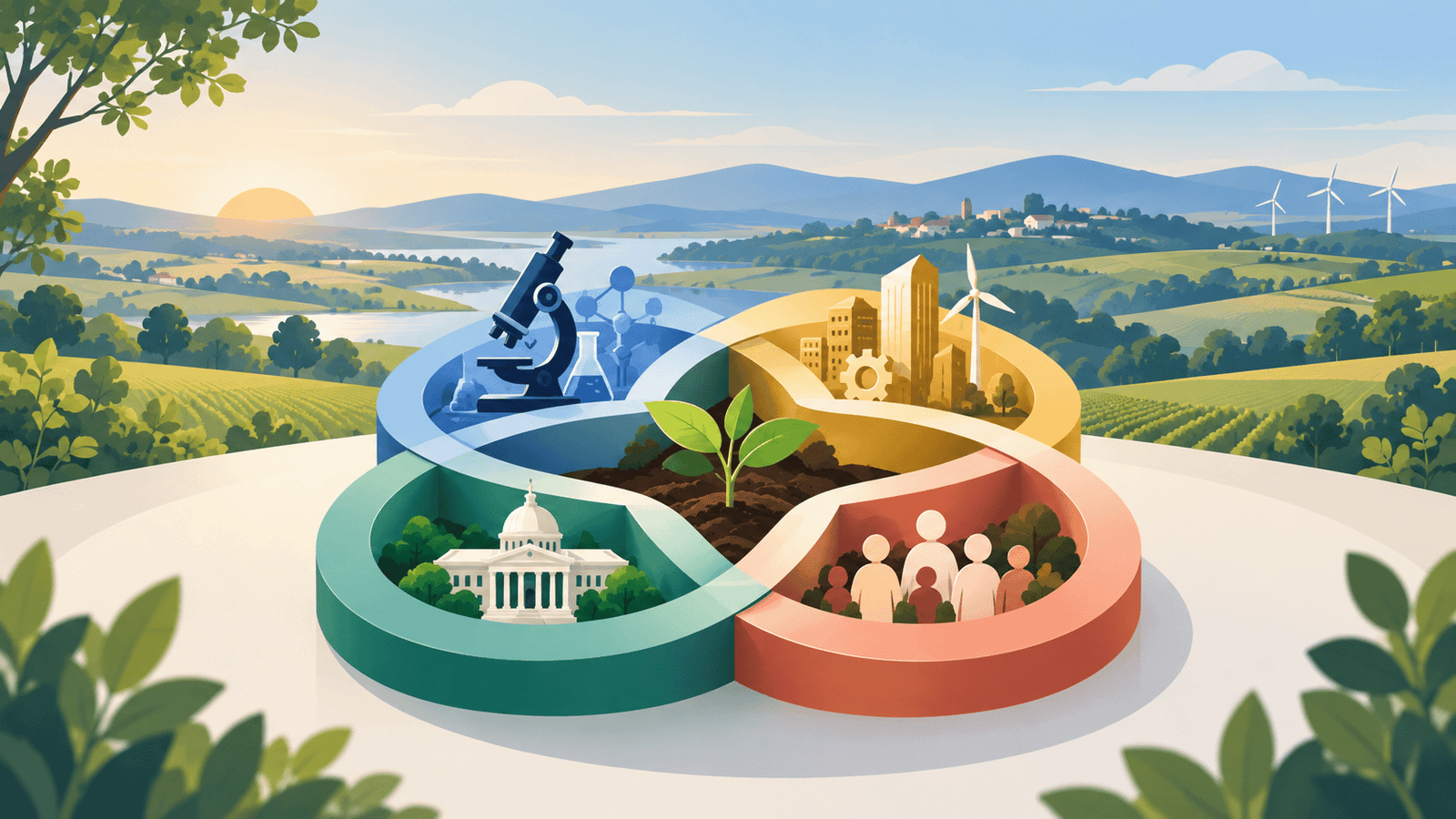
The idea is actually very simple. For innovation to have a reasonable chance of working, four worlds need to interact: science, business, public authorities and civil society. Nothing mysterious. Four different groups sitting around the same table.

The logic is straightforward. Science may demonstrate that a new agricultural practice improves soil health. A company may develop the technology needed to apply it. A public authority may create incentives or policies to support its adoption. But then the farmer points out that it requires three extra tractor passes, costs too much or works beautifully on a two-hectare trial plot but makes very little sense on a commercial farm. That observation can change the entire project. And it does not weaken the science. It improves it.

This is also why Living Labs have become so prominent in European research and innovation programmes. In the EU Mission ‘A Soil Deal for Europe’, for example, Living Labs are intended to bring researchers, land managers, businesses, authorities and citizens together to co-create, test and demonstrate solutions under real-world conditions.

And perhaps the most important word in Living Lab is not lab at all. It is living.

Because the moment research enters a real place, all sorts of things appear that rarely behave as neatly as we would like. There are people with different interests, farms with different resources, administrations with their own procedures, businesses that need the figures to add up, citizens who want to be heard and local circumstances that no model anticipated. There are droughts, changing prices, lack of time, traditions, distrust, good ideas and, occasionally, an idea that looked brilliant until somebody tried to put it into practice.

That is the real world. And if we want to change it, it makes sense to invite it into the conversation before all the decisions have already been taken.

Civil society organisations can help make that happen. They can bring into the room people who would never normally attend a scientific meeting, maintain local networks, organise participatory processes, communicate results in understandable language and, perhaps most importantly, do something that deserves far more recognition: say when something is not working.

Because participating in a project should not mean politely agreeing with everything said in a meeting. If a tool is so complicated that nobody is likely to use it, somebody needs to say so. If we run a supposedly participatory process and the same ten people turn up every time, we should probably ask why. If we expect farmers to adopt a new practice but have never seriously discussed costs, machinery or working time with them, then an important part of the research may still be missing. Sometimes innovation begins by listening to an objection.

There is another reason why these organisations matter, and it receives far less attention. Projects end. Places do not.

A European project starts on a particular date and, three, four or five years later, it finishes. The reports are submitted, the accounts are closed, the results are presented and the consortium partners move on to something else. But the following morning the farmer goes back to the field. The local authority continues to manage its territory. The river is still there. So is the soil. And the environmental problems we were trying to solve rarely pay much attention to the European Commission’s timetable.

An organisation rooted in a place can preserve something extremely valuable: continuity. The people, the contacts, the trust that has been built and part of the knowledge generated can remain long after the project itself has disappeared. One initiative can be connected to the next, avoiding that familiar situation in which every new project starts from scratch, knocking on the same doors and asking the same people the same questions all over again.

That is why an NGO or association should not be added to a consortium simply because it looks good to have a civil society organisation somewhere along the bottom row of logos. Nor should its role be reduced to organising events, writing news items and managing a LinkedIn account. If we are serious about the quadruple helix, then the fourth helix has to turn as well. It has to be able to ask questions, make proposals, disagree, connect people and contribute to decisions.

That also means civil society organisations need to be prepared for the job. They need to understand how research works, to be able to collaborate with universities and research centres, to handle complex projects and, at the same time, to keep one foot firmly outside the office. Calling yourself a representative of civil society is not enough. You still have to go out, listen and build genuine relationships.

That is one of the spaces we want to continue developing at NEST: somewhere between science and the street, between those who generate knowledge and those who will eventually use it, between a technically excellent solution and the unavoidable question of whether it will actually work once it reaches the real world.

We need good researchers. We need universities, research institutes, innovative companies and public authorities capable of turning knowledge into policy. We need better laboratories, better models and better technologies. But we also need something much simpler, and much older: different people willing to sit around the same table and listen to one another.

About the author

Dr Félix González Peñaloza is a researcher and project manager at IRNAS-CSIC (Seville, Spain), specialising in soil science, soil health and environmental research. His work focuses on sustainable soil management, soil organic matter, environmental monitoring and the coordination of European research projects, particularly within Horizon Europe initiatives and Living Labs.