
Scientific excellence is no longer measured only by what research produces. It also matters who is involved, who is heard and what changes beyond the laboratory.
For many, many years, research followed a relatively straightforward path: identify a problem, study it, generate knowledge, publish the results and, eventually, communicate those findings to society.
But…that model is changing.
Not because scientific excellence has become less important. Quite the opposite. What is changing is our understanding of how knowledge becomes useful, adopted and capable of producing lasting change. Europe is increasingly recognising something fundamental: a scientifically excellent solution can still fail if it does not respond to the realities, needs and constraints of the people expected to use it.
Farmers, businesses, public authorities, associations, local communities, environmental organisations, educators, technical advisers and citizens all hold knowledge that can be essential to solving today’s environmental and social challenges.
In European projects, we often refer to these people and organisations as stakeholders. But stakeholders are no longer expected to be simply the final recipients of research.
Increasingly, they are becoming part of the research process itself.
From consultation to co-creation
Stakeholder participation is not entirely new in European policy. Citizens, organisations and professional sectors have been consulted for many years. What has changed is the role they are now expected to play.
Across European research and innovation programmes, and particularly within initiatives such as the EU Missions and Living Labs, the emphasis is increasingly shifting from simply asking people for their opinion towards co-creating knowledge, solutions and pathways for implementation.
The distinction matters.
Consultation often means presenting an idea and asking: “What do you think?”
Co-creation begins earlier: “What is the problem from your perspective, what would a useful solution look like, and how can we develop it together?”
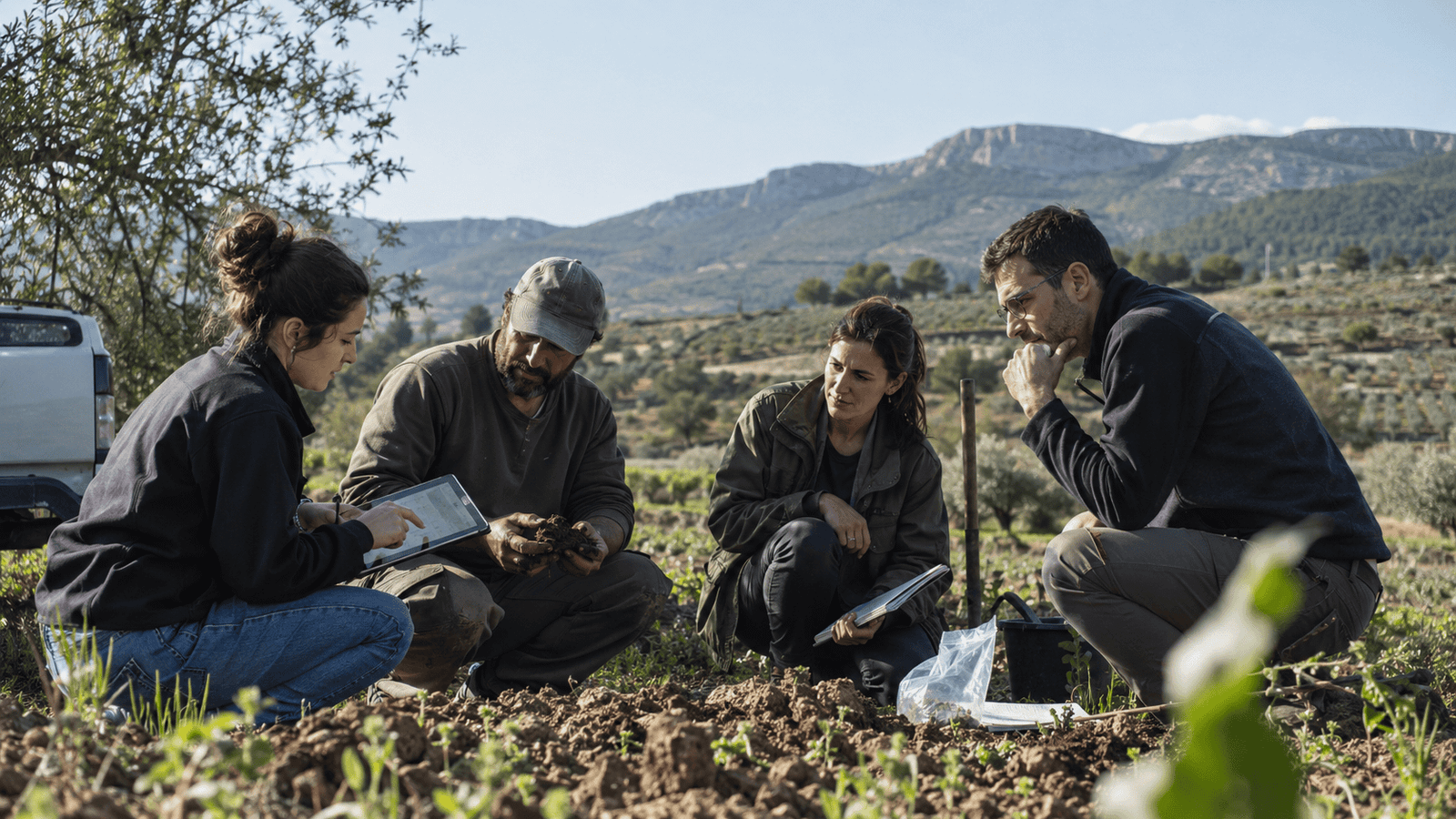
That apparently small difference can completely change the outcome of a project. It means that stakeholders are not invited only when the research is almost complete. They can help define priorities, identify barriers, assess alternatives, test solutions and determine whether an innovation is realistic in the context where it is expected to work.
This role is particularly important in fields such as soil health, agriculture, climate adaptation, biodiversity and rural development, where environmental challenges are inseparable from economic, social and territorial realities.
Because those who experience a problem possess knowledge too
A scientist may understand in detail how soil organic carbon changes over time, while a farmer may know from experience exactly how a particular field responds after several weeks without rain. A model can help predict erosion risk, but a local community may recognise why a technically promising intervention would never be accepted in that area. Public authorities can identify the regulatory barriers that might prevent implementation, while companies may see immediately that a scientifically robust solution is simply not economically viable. None of these perspectives is sufficient on its own, and none should replace the others. Their real value lies in bringing them together, because each contributes a different piece of the same problem.
We believe that meaningful stakeholder engagement should go far beyond validating decisions that have already been made by a research consortium. Stakeholders should have the opportunity to shape the process from the outset, helping to define priorities, identify barriers and contribute to the development of solutions. For that to happen, engagement must begin with somet
Participation is not the same as filling a room
A project can bring one hundred people into a room and still fail to achieve meaningful stakeholder engagement. Participation cannot be measured by numbers alone, because representation matters just as much as attendance. If most participants come from the same sector, share similar perspectives or are invited simply to listen rather than contribute, the process may appear participatory without genuinely being so.
For us, the most important questions are therefore not only how many people took part, but who they were, which perspectives were represented, who was missing and whether their contribution had any real influence on the project. At NEST, our ambition is not simply to maximise participation figures, but to build diverse, active and genuinely representative stakeholder communities that bring together science, business, public administration, civil society, local actors and citizens. Meaningful participation requires spaces where people can do more than sit in an audience: they must be able to question, discuss, challenge, propose and contribute to decisions. Participation becomes truly valuable when those involved have a genuine opportunity to shape the outcome.
But participation has another barrier: language
Even when the right stakeholders (community or actores) are in the room, another challenge remains: they need to understand one another. Science necessarily relies on a specialised language, and that precision is essential for researchers working with technical concepts, indicators, models, statistical methods and standardised protocols. Within the scientific community, terms such as SOC (Soil Organic Carbon), MRV (Monitoring, Reporting and Verification), LCA (Life Cycle Assessment) and NDVI (Normalized Difference Vegetation Index) are part of everyday professional communication, alongside concepts such as ecosystem services, soil resilience, carbon sequestration, functional biodiversity and climate scenarios.
For researchers and technical specialists, this terminology provides accuracy and a shared framework. Outside those circles, however, it can easily become a barrier. Many of the people whom research is ultimately intended to support may have extensive practical knowledge of the issue being studied without being familiar with the scientific vocabulary used to describe it. If the language of a project is difficult to understand, meaningful participation becomes much harder. People cannot fully contribute to a discussion if the questions, methods or expected outcomes are not communicated in a way that makes sense to them. This is why we believe that connecting science and society requires not only scientific expertise, but also the ability to translate complex knowledge into clear, accessible and useful language without losing its rigour.
Science needs translators
One of the principles we want to place at the heart of NEST is that scientific knowledge should be understandable without losing its scientific integrity. Bridging the gap between highly specialised research and the people who need to understand, apply or respond to it requires more than simply disseminating results; it requires the ability to adapt the way knowledge is communicated to different audiences.
This is an area in which the people behind NEST already have substantial experience. Through our previous work in research institutions, universities, companies and European projects, we have worked at the interface between science and society, communicating complex scientific results to researchers, farmers, companies, public authorities, practitioners and citizens. That experience has shown us that effective knowledge transfer depends not only on the quality of the science, but also on the ability to make that science meaningful to the person receiving it.
At NEST, we describe this as translating science. We do not mean translating from one language into another, but translating between different ways of understanding and communicating knowledge. This does not mean oversimplifying scientific results, removing complexity where it is necessary or compromising rigour. It means recognising that the same result may need to be explained differently depending on the audience.
A researcher, for example, may need to know that a particular management practice produced a statistically significant increase in soil organic carbon. A farmer may be interested in the same result, but their questions are likely to be different: Will this improve my soil? How long will it take before I notice a difference? What will it cost? What would I need to change in my current management? What risks are involved?
Both are discussing exactly the same scientific finding, but from different perspectives and using different forms of language. Being able to move confidently between those perspectives is therefore much more than a communication exercise. For NEST, it is an essential part of knowledge transfer itself, and one of the areas in which the collective experience of our team can bring real added value.
And translation must work in both directions
There is another side to scientific translation that is just as important and too often overlooked: it cannot work in only one direction. If science is to engage meaningfully with society, knowledge must move not only from researchers towards stakeholders, but also from stakeholders back towards research.
A farmer who says, “This soil holds less water every year” may be expressing, in practical terms, a change related to soil structure, organic matter, infiltration, compaction or water-holding capacity. Likewise, when a local community says, “That solution will not work here,” they may be identifying an economic, cultural, logistical or institutional barrier that has not been captured by a scientific model or experimental design.
These observations are not anecdotal details to be noted and set aside. They are valuable forms of knowledge that need to be interpreted, structured and translated into information that researchers, engineers, policymakers and project managers can use in their decisions. This is also something the people behind NEST have experience in: working between technical, scientific and stakeholder environments, identifying what different groups are actually saying and helping convert those perspectives into useful inputs for research, planning and implementation.
That’s why, at NEST we prefer to speak of dialogue rather than dissemination. Dissemination can suggest a one-way flow of information; dialogue implies exchange, interpretation and mutual learning.
Science → society. Society → science.
When both directions are active, co-creation stops being a slogan and becomes a real working method.
From stakeholders to impact
There is a very practical reason why their participation has become so important: research only creates real impact when its results move beyond reports, scientific papers and project websites and begin to influence decisions, practices and behaviours. In other words, impact requires adoption.
That adoption is much more likely when people understand the solution, recognise the problem it is addressing and feel that their own knowledge, needs and experience have been taken into account during its development. People tend to support what they understand, to adopt what they have helped to shape, and to continue using solutions that respond to a genuine need rather than to one defined only from outside their reality.
And…, we do not believe stakeholders (farmers, NGO’s, etc) should appear only at the end of a European project under a heading such as communication and dissemination. Their role should begin much earlier, when the problem is being framed, priorities are being discussed and possible solutions are still open to change. Ideally, stakeholder engagement should start with the very first question, because the foundations of impact are often laid long before the final results are produced.
The way we want to work at NEST
NEST was created at the intersection of science, sustainability, innovation and social transformation, bringing together applied research, environmental knowledge, education, international cooperation, digital tools, scientific communication and citizen participation. But beyond these areas of work, we want to contribute something very specific: the ability to connect communities that too often operate in parallel and speak different professional or social languages.
That means creating meaningful links between researchers and farmers, technology and territory, public authorities and citizens, businesses and scientific knowledge, and European projects and the communities where change is expected to happen. We believe that building these connections is becoming one of the central challenges of modern research, because scientific excellence alone does not guarantee transformation.
Knowledge must be understood, shared and questioned, and it must also be capable of listening in return. At NEST, our aim is to help create the conditions for that exchange, so that research becomes more relevant, more accessible and more closely connected to real needs.
For us, scientific knowledge should not end when a research project finishes. It should continue through the decisions, practices, relationships and changes that follow.
We do not want to bring science to society only once the research is finished. We want society to be part of the research from the very beginning.