
Why an old feature of the farming landscape is being rediscovered as a tool for soil protection, biodiversity and climate resilience.
Did you know that, for decades, hedgerows disappeared from many European farming landscapes almost without anyone paying much attention? They were said to get in the way of machinery, break up fields and occupy land that could otherwise be cultivated. The argument was simple: modern farming needed fields that were bigger, straighter and cleaner. In other words, the landscape became increasingly uniform.
And yet, rather surprisingly, some farmers are now beginning to bring them back.
That is exactly what is happening in the United Kingdom, where thousands of farms have applied for support to restore old hedgerows or plant new ones. They are not doing it out of nostalgia, or to recreate an idealised image of the countryside. They are doing it because these narrow corridors of vegetation can help address some of the most serious challenges facing agriculture today: soil erosion, biodiversity loss, runoff during intense rainfall and, to some extent, adaptation to climate change.
At first, the story may not sound particularly dramatic. After all, we are talking about little more than shrubs growing between two fields. But behind that line of vegetation, far more is happening than we might imagine.
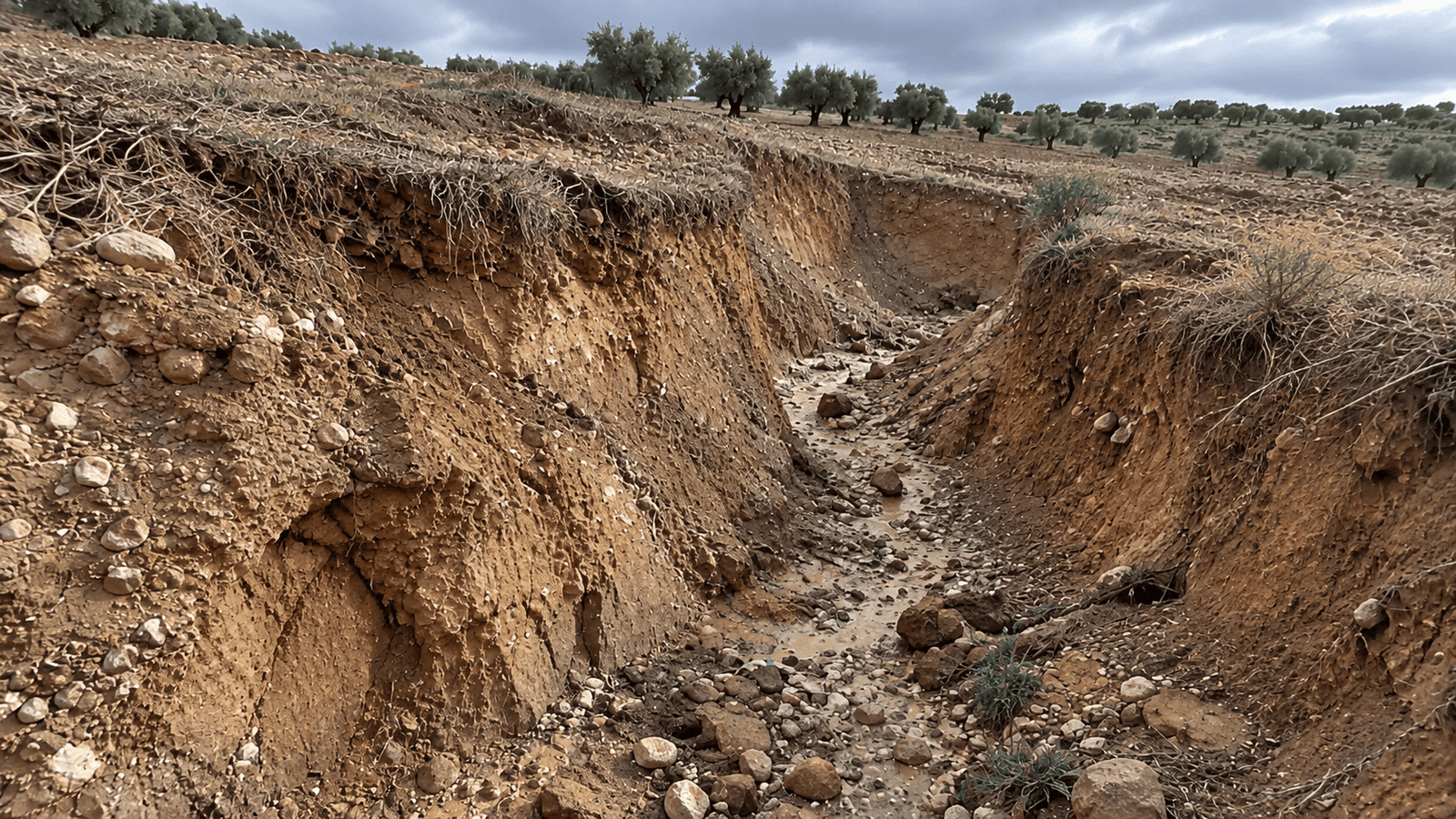
When intense rain falls on cultivated land – as can happen during torrential storms in the Mediterranean – water can quickly begin to move across the soil surface. This is runoff. As it travels, it can carry away soil particles, organic matter and nutrients. The problem is particularly clear on sloping ground or where soils have lost structure and protective vegetation cover.
This is precisely where a hedgerow can make a difference. Its roots help hold the soil together, the vegetation slows the movement of water, and the accumulation of leaves and other organic material creates conditions that favour infiltration. Instead of all the water rushing downhill, a greater proportion has the chance to remain where it falls.
No single hedgerow can stop a flood. But landscapes do not work through one large solution. They work through many small structures which, when connected, can alter the way water, soil and nutrients move across an area.
That may be one of the keys to their return
For years, we have learned to look almost exclusively inside the agricultural field. We talk about fertilisation, tillage, irrigation, crop varieties, productivity and new technologies. Yet many of the processes that determine the health of a landscape take place in the spaces between fields.
A strip of vegetation can provide refuge for insects. A small group of shrubs can offer food and shelter for birds. A line of trees can reduce wind exposure. A vegetated margin can become a corridor that allows species to move between areas that would otherwise be completely isolated.
And all of this can happen without completely transforming the farming system. Sometimes, the first step is simply to conserve what is already there.
When these elements disappear, the landscape becomes simpler
Large monocultures can be highly efficient from a production point of view, but a landscape made up almost entirely of cultivated surfaces leaves fewer opportunities for biodiversity and fewer barriers against erosion and runoff.
The point is not to set food production and nature against each other, as though they were incompatible. It is to find ways of bringing some heterogeneity back into agricultural landscapes without giving up their productive function. That is why more initiatives are beginning to focus on restoring part of the complexity that has gradually been lost.
Hedgerows are one example, but they are not the only one.
Hedgerows are only one part of the picture
There is little doubt that, in the Mediterranean, it would make no sense simply to copy the British model. The climate is different, water is far more limited, the vegetation is different and wildfire risk adds another factor that cannot be ignored.
But the idea behind hedgerows can certainly travel.
Here, the same role might be played by margins of native vegetation, herbaceous strips, scattered trees, vegetation along streams and drainage channels, small biodiversity islands or corridors connecting different natural areas within farmland.
In fact, many of these features are not new to Mediterranean agriculture at all. For centuries, field boundaries, isolated trees, small patches of woodland, riparian vegetation, tracks bordered by spontaneous plants and uncultivated margins were familiar parts of the landscape, long before agricultural intensification began to simplify many of these spaces.
So perhaps this is not so much about designing an entirely new landscape as it is about recovering some of the complexity that we gradually removed.
And that complexity may become increasingly important. In a future marked by more irregular rainfall, longer droughts, extreme heat and growing pressure on agricultural soils, a landscape that can retain water, protect soil and provide refuge for different species is no longer simply a matter of appearance. It becomes a question of resilience.
Perhaps we need to look again at the edges of our fields
There is also a cultural side to this story.
For a long time, a well-managed field was associated with a very particular image: clearly defined lines, clean soil, bare edges and vegetation outside the crop kept firmly under control. A tidy field was, in some ways, taken as evidence of a well-run farm.
But perhaps we need to learn to look at these landscapes differently.
A flowering margin may be feeding pollinators. A strip of vegetation may be trapping sediment. A small group of shrubs may provide shelter for birds and beneficial insects. And a line of vegetation between fields may help rainwater stay just a little longer where it falls.
What looks like unproductive space may, in fact, be providing essential services to the farming system as a whole. Once we see it that way, our understanding of the landscape begins to change.
This is not about filling fields with obstacles, romanticising the past or pretending that hedgerows alone can solve the environmental challenges facing agriculture. It is simply about recognising that heterogeneity has value.
At a time when we talk constantly about precision agriculture, sensors, drones, satellites, artificial intelligence and models capable of predicting what may happen to our crops, there is something striking about the fact that one of the ideas attracting renewed interest is as simple as a line of shrubs between two fields.
Perhaps that is exactly what makes this story so interesting.
The agriculture of the future will need technology, without question. But it will also need healthy soils, water that can infiltrate, insects, birds, vegetation and landscapes that are better able to respond to extremes.
And part of that response may be found in places we have overlooked for far too long: the edges of our fields.
That is why the quiet return of agricultural hedgerows is more than a curiosity of the British countryside. It is an invitation to ask a much bigger question:
Have we made our agricultural landscapes too simple?