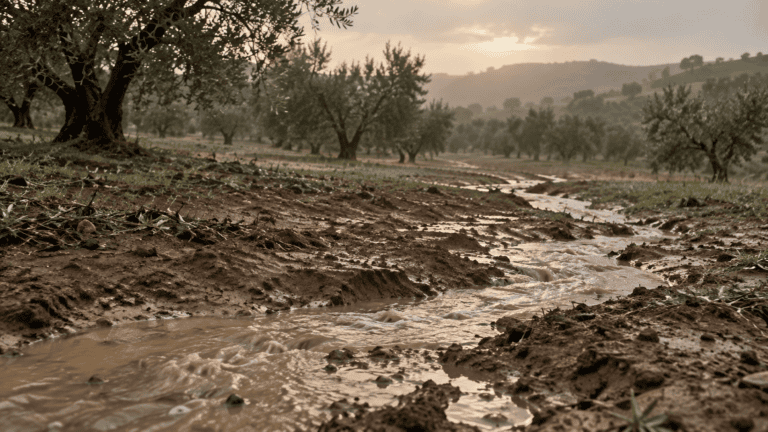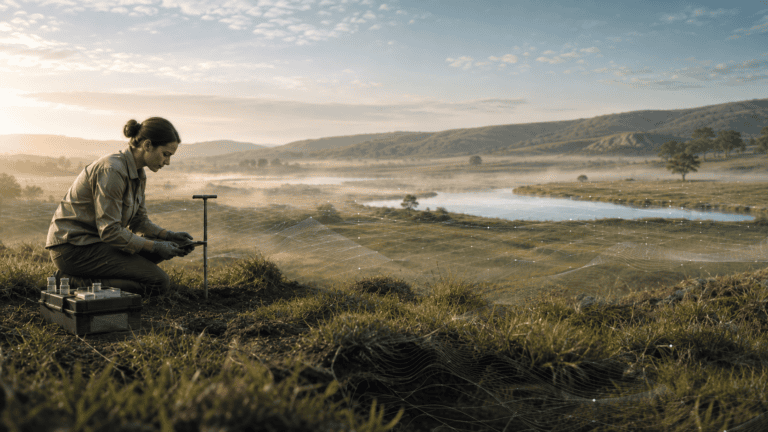

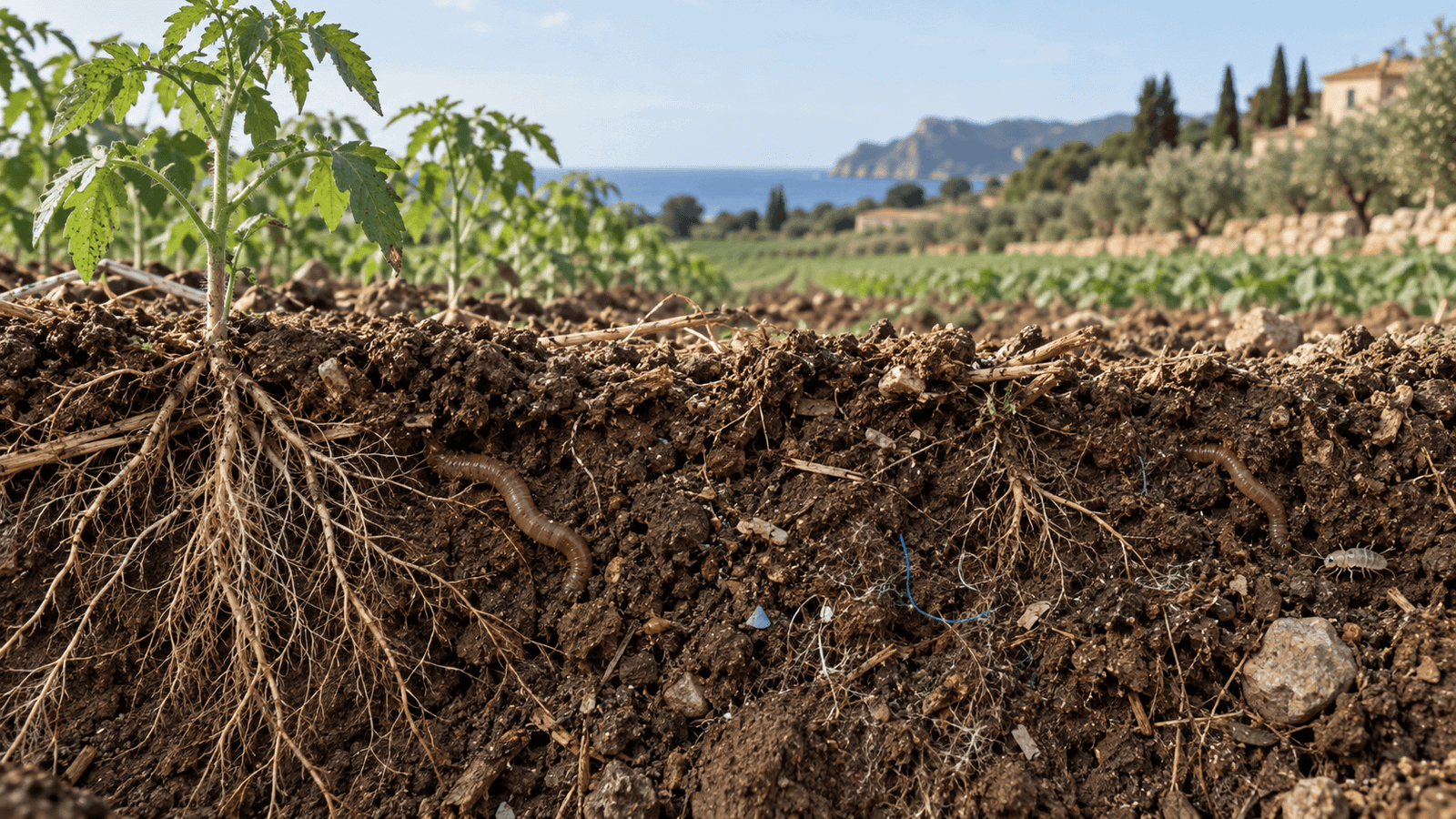
When we think about plastic pollution, we usually look towards the sea. But perhaps we should also start looking down – at the soil beneath our feet, and at the place where much of our food begins.
Picture an ordinary field or landscape for a moment. At first glance, it looks clean. There is soil, there are plants, perhaps a few remains from the previous crop. Nothing especially worrying. Yet among grains of sand, clay, organic matter, roots and microorganisms there may be thousands of tiny plastic particles. Some are too small for us to see. Others may have been there for years. And many could remain for decades.
That is one of the reasons microplastics are such a difficult environmental problem: most of the time, we cannot see them.
For years, plastic pollution has been associated with things we can easily recognise – a bottle, a bag, a discarded container. But plastic does not always disappear when it is no longer visible. Sunlight, heat, abrasion, cultivation and simply the passage of time can break larger items into smaller and smaller fragments. Once those particles are below five millimetres, we generally call them microplastics. At even smaller scales, we enter the world of nanoplastics.
What was once a single object that could be picked up can eventually become thousands or millions of particles dispersed through the environment. And at that point, the nature of the problem changes completely.
We can remove a bottle from the beach, and we can take a plastic bag out of a river – which is highly recommended and we should be grateful for – but…how do we separate millions of microscopic plastic particles from tonnes of agricultural soil without damaging the soil itself? That question matters because we now know that microplastics can reach farmland through many different routes.
Some are easy to understand. Modern agriculture uses plastic in mulching films, irrigation pipes, nets, greenhouses, seedling trays, packaging and many other products that make food production easier and, in many cases, help save water or improve yields. The difficulty begins when these materials age and fragment.
But there are other, far less obvious routes – and one of them begins much closer to home
Every time we wash certain synthetic clothes, tiny plastic fibres can be released. They travel with wastewater to treatment plants, where a large proportion may be captured during treatment. That sounds like good news. The problem is that the particles have not vanished. Many become concentrated in sewage sludge.
Once properly treated and provided it meets the relevant regulations, sewage sludge can be applied to agricultural land because it contains organic matter and useful nutrients. This creates an uncomfortable paradox: we may be recycling nutrients and returning valuable organic matter to soils while, at the same time, returning persistent contaminants.
A study of 16 agricultural fields in eastern Spain found a clear relationship between sewage-sludge application and the amount of microplastic found in soil (link). Fields that had never received sludge contained, on average, about 2,030 microplastic particles per kilogram of soil. In fields that had received sludge, the average was above 5,000 particles per kilogram. The number of particles also tended to rise as the number of applications increased.
These were real agricultural fields, not just laboratory experiments
Perhaps the figure that should make us think most carefully, however, is not only how much plastic can enter a soil, but how long it can remain there. A study published in 2025 examined agricultural plots with a history of sewage-sludge application over 25 years. Decades later, microplastics were still present. Some particles showed signs of degradation, while others persisted much longer. In other words, choices made today may leave a signature in the soil for a generation or more.
At this point, a reasonable question is: does it really matter if there are tiny pieces of plastic mixed into the ground? To answer that, we need to remember something that is surprisingly easy to forget.
Soil is alive!
It is not simply a mixture of sand, clay and stones that holds plant roots in place. A handful of healthy soil can contain millions of bacteria, fungi and other microorganisms. It is also home to earthworms, nematodes, springtails, mites and an extraordinary diversity of organisms that we rarely see but that are constantly at work.
They decompose organic matter. They release nutrients. They build aggregates. They create pores. They help water infiltrate. They contribute to carbon storage. And they help plants grow.
In a sense, there is an enormous invisible city beneath our feet. Introducing millions of particles of a new and persistent material into that city can change some of its rules.
Experiments over the past few years have shown that certain microplastics can alter properties as fundamental as soil density, porosity, aggregation and the way water is stored and moves through the soil.
There is an important qualification, though: there is no single thing called ‘a microplastic’. A polyester fibre does not behave in the same way as a fragment of polyethylene. A relatively large particle does not interact with soil like a microscopic one. A very low concentration may also have a very different effect from a high one.
That is why science cannot give us a simple answer such as ‘microplastics are toxic’ or ‘microplastics are harmless’. The reality is more interesting – and more complicated.
Studies of soil organisms are nevertheless beginning to reveal patterns. A meta-analysis bringing together results from more than 90 studies found changes in microbial communities and negative effects on some soil animals, including earthworms, nematodes and springtails.
Another major analysis, published in the Journal of Hazardous Materials with participation from IRNAS-CSIC, brought together 128 studies to examine how microplastics may influence terrestrial ecosystem services. Across the studies considered, the researchers reported average reductions of roughly 14.5% in plant productivity, 8.2% in soil fertility and 3.4% in microbial biodiversity.
Those figures need context. They do not mean that our farms are about to produce 14.5% less food. They are average effects calculated across very different experiments involving different plastics, concentrations, plants and soils. But they do tell us something important: plastic is not always an inert passenger in soil. Under some conditions, it can interfere with processes that help the ecosystem function.
And that brings us to the question most readers will probably be asking: can plastic end up inside the plants we eat?
We know that sufficiently small particles can enter some plants under certain conditions. A study published in Nature Sustainability showed that microscopic plastic particles could enter the roots of wheat and lettuce through small openings associated with the emergence of lateral roots. Some particles could then move towards the above-ground parts of the plant.
That is an important finding. But we should resist jumping directly from it to the headline ‘we are eating plastic’. The fact that a particle can enter a plant experimentally does not mean that all our food is full of microplastics, or that it is unsafe.
We still need to know how much reaches crops under normal agricultural conditions, which particle sizes can do so, which plants are most vulnerable, whether particles reach the parts that we actually eat and, above all, what any resulting exposure means for human health. Science is still working on those questions, and acknowledging what we do not yet know is just as important as explaining what we do.
In fact, the relationship between microplastics and food security may be broader than the question of whether a particle ends up inside a lettuce leaf. Our food depends on having soils capable of producing it.
We need soils that can hold water through drought, retain nutrients, allow roots to develop, support diverse microbial communities and recover after intense rainfall or heatwaves. Those soils are already under pressure from climate change, erosion, compaction, salinisation, loss of organic matter and chemical pollution. Microplastics add another pressure to that list. It may not be the most visible one, but that is precisely why it is so easy to overlook.
A problem that does not end with plastic
There is another reason this pollution deserves attention. A plastic particle that reaches the soil does not necessarily remain isolated. Its surface begins to interact with the environment around it.
It can interact with metals, pesticides and other contaminants. It can also be colonised by microorganisms, which form small communities on the plastic surface. Researchers increasingly refer to these microbial communities as the plastisphere.
Scientists are also investigating whether plastic surfaces may contribute to the movement of particular microorganisms or genes associated with antimicrobial resistance. Much remains uncertain, but the concept matters: a microplastic particle is not always just a piece of material lost among soil grains. Over time, it can become a new surface for interactions within the ecosystem.
Nor can we assume that particles stay exactly where they entered the soil. Microplastics can move into deeper layers, travel with water, be transported by erosion and even return to the atmosphere. Experiments on agricultural soils receiving biosolids have shown that wind erosion can preferentially carry some plastic particles, partly because many plastics are lighter than mineral soil particles.
So a soil can be both a destination for plastic pollution and a secondary source from which particles begin to travel again.
What can we do?
Perhaps we do not need to keep asking whether we should be ‘worried’. A more useful word may be responsibility.
We already know enough to recognise that there is a problem. We know that plastic is reaching agricultural soils. We know that some particles can persist for decades. We know that they can alter certain physical and biological properties of soils, affect some organisms and ecosystem processes, and that the smallest particles can enter particular plants under certain conditions.
At the same time, there is a great deal we still do not know. We do not yet understand well enough the consequences of accumulating small quantities year after year for fifty or a hundred years. Nor do we fully understand how these materials will interact with other pressures such as drought, extreme temperatures, chemical contamination or declining soil organic matter.
Uncertainty does not need to become fear. But neither should it become an excuse for doing nothing
There is a fundamental difference between preventing this pollution and attempting to solve it afterwards. When we find a discarded bottle, we can pick it up. When we see a bag on a beach, we can remove it. But once the same plastic has become millions of microscopic particles dispersed through millions of tonnes of soil, the solution becomes far more difficult.
Much of the response therefore has to happen before plastic reaches the field: designing agricultural materials better, preventing fragmentation, collecting and recycling used plastics properly, improving wastewater treatment, understanding more clearly what enters farmland through sludge, compost and other soil amendments, developing biodegradable materials that genuinely degrade under the conditions in which they are used, and monitoring what is happening in our soils.
We also need long-term research. Many existing studies are laboratory experiments or run for relatively short periods. Agricultural soil, however, functions over decades. We need to know not only what happens three months after plastic is added, but what happens after twenty, thirty or fifty years of repeated inputs. That difference is crucial.
Much closer to us than it seems
Perhaps the most important part of this story is understanding that microplastics in an agricultural field are not simply ‘a farmers’ problem’.
One fibre may have come from our clothing. Another from a tyre. Another from packaging. Another from plastic film used to produce the food we buy. Water, wind and our systems for treating wastewater and managing waste can transport those particles until they reach a soil.
That soil will grow a plant. And that plant may one day reach our table.
Everything is connected.
This is not about finding someone to blame. We are all part of the same system, and that means we can also be part of the solution.
For decades, we have looked towards the ocean to understand the scale of plastic pollution. Perhaps now we also need to look down – at the soil we walk on without thinking, the soil that stores rainwater, the soil that holds carbon, the soil that supports an extraordinary biodiversity we rarely see and, above all, the soil that makes something as ordinary as our daily food possible.
The next major chapter in the story of plastic pollution may not be floating in the ocean.
It may already be beneath our feet.