
May 10, 2025

What Is Soil Bulk Density and Why Should You Care?
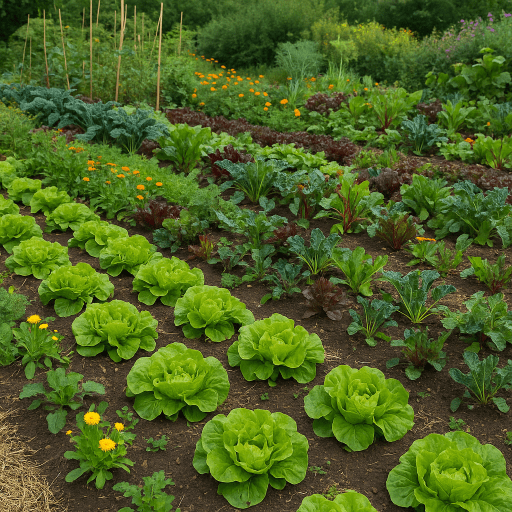
Soil bulk density is, quite simply, the mass of dry soil solids per unit volume, expressed in kg/dm³ (or g/cm³). It reveals how tightly the soil particles—sand, silt and clay—are packed together, including the pore spaces between them. A higher bulk density means the soil is more compacted and less porous; a lower bulk density indicates a looser, more sponge-like structure that can hold water and air more readily.

A Down-to-Earth Analogy
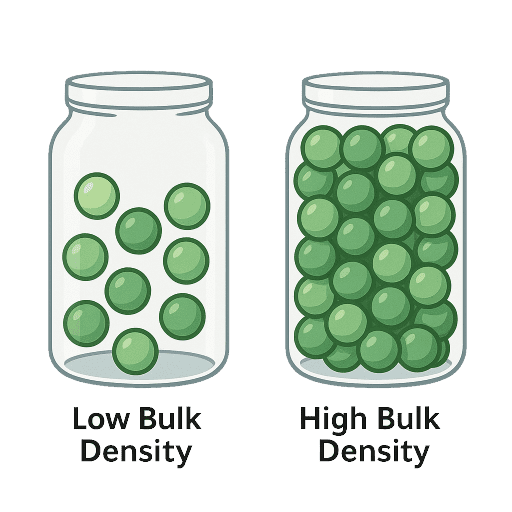
BulkDensity_Example

Imagine two jars of marbles. One jar is loosely filled, with plenty of gaps between the marbles; the other is shaken until the marbles settle as tightly as possible. The first jar mimics soil with low bulk density—lots of pore space—while the second jar represents soil with high bulk density, where the particles are closely packed and water struggles to infiltrate.

How It Matters to Farmers

Consider three practical scenarios that illustrate bulk density’s importance:

  1. Tillage and Compaction
    • Suppose a field of winter wheat has a bulk density of 1.60 kg/dm³ in the top 5 cm. After a 20 mm irrigation, water drains through in under two hours—far too quickly for optimal root uptake.
    • By subsoiling and reducing bulk density to 1.30 kg/dm³, the same field might retain moisture for six hours, helping roots stay hydrated and boosting yield by up to 12 %.
  2. Irrigation Scheduling
    • A sandy, dense soil (1.55 kg/dm³) at 15 cm depth may only hold 10 % of its volume in water, necessitating irrigation every three days.
    • In contrast, a loam with lower bulk density (1.25 kg/dm³) can retain 25 % water, allowing irrigation intervals of five to six days—a potential 30 % annual water saving.
  3. Machinery Traffic
    • Each pass of a 12-tonne tractor can increase bulk density by 0.20 kg/dm³ down to 20 cm depth.
    • By restricting machinery to permanent wheelings and avoiding multiple passes over the same line, farmers can limit soil compaction and preserve structure.

Why Scientists Value Bulk Density

Bulk density underpins models of erosion, hydrology and climate interactions:

  • Erosion Risk: On a 15 ° slope, soils over 1.6 kg/dm³ might generate 40 % more surface runoff and lose up to five tonnes of sediment per hectare in a 30 mm storm than soils at 1.2 kg/dm³.
  • Carbon Sequestration: Denser soils store less organic matter, reducing CO₂ sequestration potential by around 15 % over decades.
  • Water Balance: Incorporating bulk density into groundwater recharge models refines aquifer yield forecasts and helps urban planners gauge subsidence risks where heavy landscaping is common.
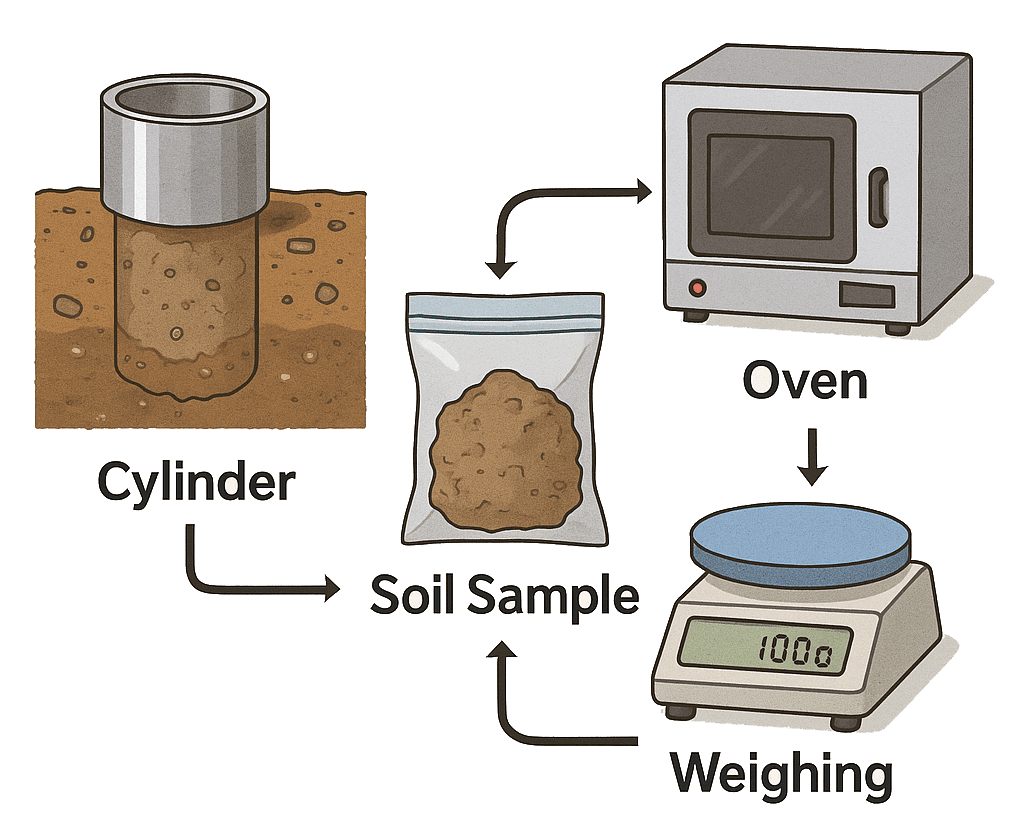
Measuring_Bulk_Density

Introducing the Soil Bulk Density GeoViewer

To bridge the gap between soil science and practical fieldwork, we’ve developed an interactive Bulk Density GeoViewer that brings bulk density maps straight to your fingertips. Rather than wrestling with printed charts or abstract numbers, this tool displays real-time bulk density data overlaid on a familiar street-map backdrop, so you can:

  • Instantly locate yourself in the field via your browser or mobile device’s GPS.
  • Visualise bulk density in the top 0–5 cm of soil using SoilGrids’ high-resolution WMS service.
  • Adjust transparency on the fly with a simple slider, letting you compare subsurface data against roads, boundaries or other map layers.
  • Refer to an intuitive legend that uses a green-to-blue colour ramp—mirroring the soil’s compaction levels—so even non-experts can interpret the map at a glance.
  • See the scale bar for quick distance checks and activate the measurement tool to calculate areas in hectares or distances in metres.

By combining geolocation, real-time WMS imagery and user-friendly controls, the GeoViewer empowers both farmers and researchers to:

  • Pinpoint zones of excessive compaction that may benefit from targeted subsoiling.
  • Monitor how bulk density evolves over time—before and after tillage or heavy machinery traffic.
  • Plan irrigation schedules based on precise, location-specific soil porosity.
  • Share customised views with agronomists or colleagues via a simple link.

Ready to unlock your soil’s hidden potential?

Access our free Soil Bulk Density GeoViewer now—no downloads, no fees, just instant insights. Click below to start exploring your land’s compaction patterns and make smarter, data-driven decisions today!

We use cookies to personalise content and ads, to provide social media features and to analyse our traffic. We also share information about your use of our site with our social media, advertising and analytics partners. View more
Cookies settings
Accept
Privacy & Cookie policy
Privacy & Cookies policy
Cookie name Active

Who we are

Suggested text: Our website address is: http://nestspain.org.

Comments

Suggested text: When visitors leave comments on the site we collect the data shown in the comments form, and also the visitor’s IP address and browser user agent string to help spam detection.

An anonymized string created from your email address (also called a hash) may be provided to the Gravatar service to see if you are using it. The Gravatar service privacy policy is available here: https://automattic.com/privacy/. After approval of your comment, your profile picture is visible to the public in the context of your comment.

Media

Suggested text: If you upload images to the website, you should avoid uploading images with embedded location data (EXIF GPS) included. Visitors to the website can download and extract any location data from images on the website.

Cookies

Suggested text: If you leave a comment on our site you may opt-in to saving your name, email address and website in cookies. These are for your convenience so that you do not have to fill in your details again when you leave another comment. These cookies will last for one year.

If you visit our login page, we will set a temporary cookie to determine if your browser accepts cookies. This cookie contains no personal data and is discarded when you close your browser.

When you log in, we will also set up several cookies to save your login information and your screen display choices. Login cookies last for two days, and screen options cookies last for a year. If you select "Remember Me", your login will persist for two weeks. If you log out of your account, the login cookies will be removed.

If you edit or publish an article, an additional cookie will be saved in your browser. This cookie includes no personal data and simply indicates the post ID of the article you just edited. It expires after 1 day.

Embedded content from other websites

Suggested text: Articles on this site may include embedded content (e.g. videos, images, articles, etc.). Embedded content from other websites behaves in the exact same way as if the visitor has visited the other website.

These websites may collect data about you, use cookies, embed additional third-party tracking, and monitor your interaction with that embedded content, including tracking your interaction with the embedded content if you have an account and are logged in to that website.

Who we share your data with

Suggested text: If you request a password reset, your IP address will be included in the reset email.

How long we retain your data

Suggested text: If you leave a comment, the comment and its metadata are retained indefinitely. This is so we can recognize and approve any follow-up comments automatically instead of holding them in a moderation queue.

For users that register on our website (if any), we also store the personal information they provide in their user profile. All users can see, edit, or delete their personal information at any time (except they cannot change their username). Website administrators can also see and edit that information.

What rights you have over your data

Suggested text: If you have an account on this site, or have left comments, you can request to receive an exported file of the personal data we hold about you, including any data you have provided to us. You can also request that we erase any personal data we hold about you. This does not include any data we are obliged to keep for administrative, legal, or security purposes.

Where your data is sent

Suggested text: Visitor comments may be checked through an automated spam detection service.

Save settings
Cookies settings